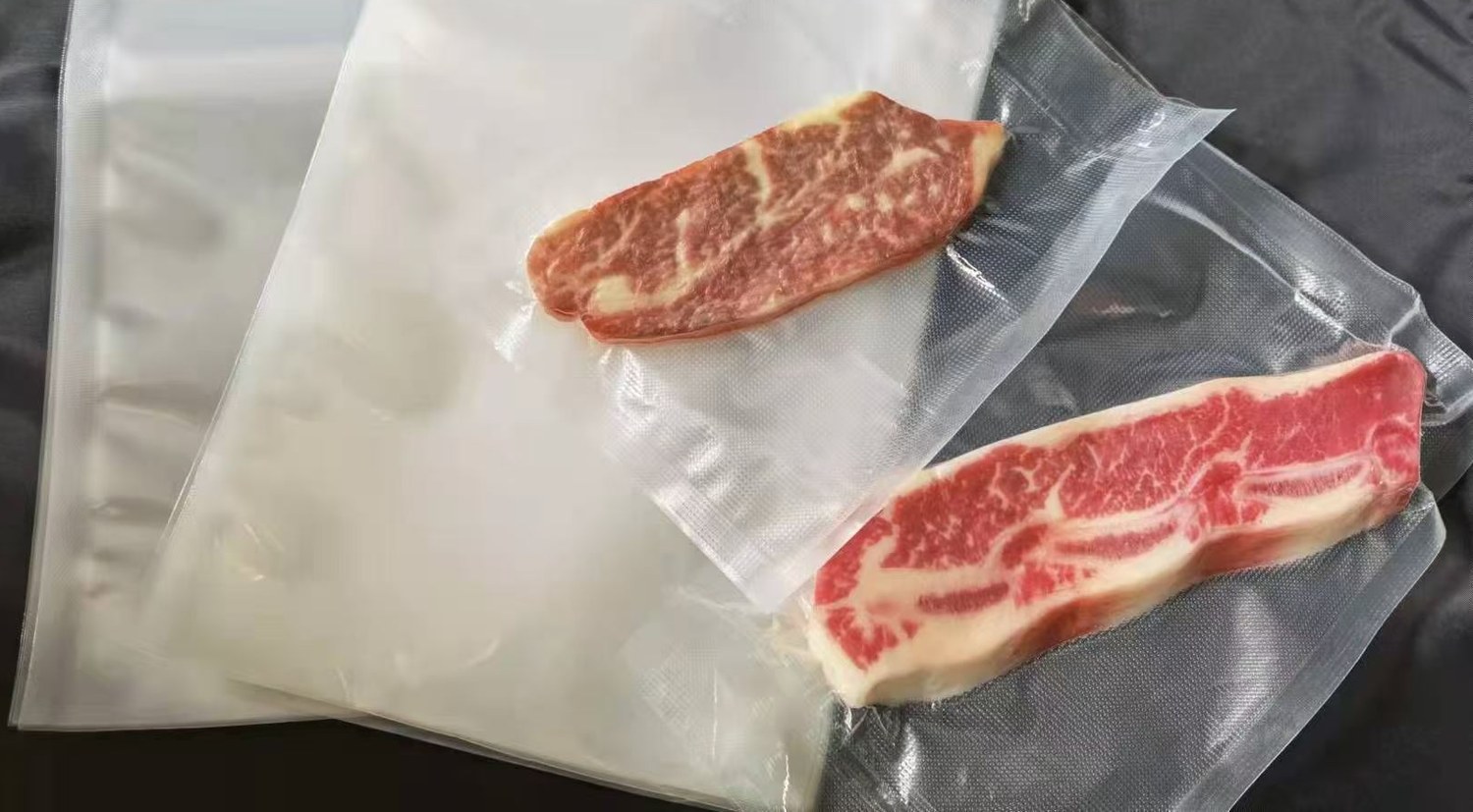
Three-side seal bag
The most common vacuum format for meat, seafood, and vegetables. Max width 60 cm, length 90 cm.
- PA/PE
- Clear or printed
- High barrier
Vacuum bags · PA/PE · PET/PE · retort
Three-side seal, stand-up, zipper, and eight-side seal bags in PA/PE or PET/PE. High barrier, -40°C freeze, and 121°C retort options for meat, seafood, cooked food, grains, and prepared dishes.
Bag types
From a simple three-side seal bag to a printed stand-up pouch, the structure and bag style are chosen together.
The most common vacuum format for meat, seafood, and vegetables. Max width 60 cm, length 90 cm.
Retail-ready stand-up bags with zipper or tear notch for cooked food, grains, and prepared dishes.
121°C, 30 minutes without bag failure. For ready meals, sauces, and shelf-stable food.
Reinforced structure for bone-in meat, seafood, and sharp ingredients that can pierce a standard bag.
Specifications
Typical ranges below. Tell us the food, weight, shelf life, and cooking process and we will confirm the structure.
| Parameter | Typical range | Notes |
|---|---|---|
| Materials | PA/PE, PET/PE, PET/PA/RCPP, aluminum | Selected by barrier and temperature |
| Bag types | Three-side seal, stand-up, zipper, eight-side seal | Custom size and print |
| Max size | Width 60 cm; length 90 cm | Larger sizes on request |
| Thickness | 70–250 µm | Common vacuum bags 70–100 µm |
| Barrier | Normal ≤2; high barrier <0.35 | Units depend on test method |
| Temperature | -40°C freeze; 121°C retort | Selected structures only |
| MOQ | 5,000 pcs | Depends on size and print |
| Lead time | 7–15 working days | Confirmed at order |
Indicative values only. Final specification, MOQ, and lead time are confirmed in the quotation. Food-contact and migration reports apply to specific structures and markets.
Applications
From frozen seafood to ready meals, the bag has to hold vacuum, survive handling, and protect the product.
Bone-in and boneless cuts, with high-puncture options for sharp edges.
Salmon, fillets, and shellfish in clear or printed vacuum bags.
Retort and sous-vide bags for ready meals, sauces, and prepared dishes.
High-barrier bags for rice, nuts, coffee, and dry ingredients.
We will recommend the structure, thickness, and bag type — and send a sample for your vacuum and cook test.
FAQ
Send the food, weight, and cooking process — we will reply with a structure recommendation.
Ask on WhatsAppThree-side seal, stand-up, zipper, flat-bottom, and eight-side seal bags. Three-side seal is the most common for vacuum packing.
Common vacuum bags are 70–100 µm; heavy-duty and high-puncture bags can go to 250 µm. Thicker is not always better — the structure and barrier matter more than thickness alone.
PA/PE and PET/PE are common; retort bags use PET/PA/RCPP or aluminum structures. The choice depends on barrier, temperature, and shelf life.
Many PA/PE bags can hold hot food, but do not vacuum immediately — steam and moisture can weaken the seal. Let the food cool to a safe temperature first.
Selected retort structures can withstand 121°C for 30 minutes. “Hot fill” is not the same as “retort”; tell us the process and we will confirm the structure.
Yes, our vacuum bags are designed to remain flexible at -40°C for frozen storage and cold-chain transport.
Water or oil on the seal area, wrinkles, insufficient heat or time, a thick structure, or a worn heating bar. Dry the bag mouth, flatten it, adjust the machine, and clean the bar.
A false seal looks closed but has low strength. Do a light pull test on both sides of the seal; if it opens, adjust the machine or structure.
Wrong bag type for the machine, misaligned mouth, moisture or oil, non-vacuum material, or a puncture. Use a vacuum-grade bag, keep the mouth flat and dry, and match the bag to the machine.
External-suction household machines usually work better with textured bags; chamber machines can use standard bags. Tell us the machine type.
Standard bags can be pierced by bones or shells. Use a high-puncture structure, or add a protective layer around the sharp area.